

Virgins
Thoughts on Devotion


My word of the year is Devotion. I chose this after seeing Heaven Sent Honey’s video, please just get up and do the thing you love doing.1 So, here I am, back from the dead, emerging from the silence of this Substack to do the damn thing! Though I’ve written more this year than I have ever before, it’s all been done the privacy of my hard drive, so yes, I’ve been doing the damn thing, just not quite on here. Where was I? Oh yes, devotion.
The trauma of Catholicism made me forget that devotion is something you can choose for yourself. For those who grew up in secular households without the pressures of choosing the religion that has been in the family for generations, I imagine that coming to this concept might be even more foreign. We’ve (I’ve) been plagued with the idea that religiosity is constraining…but it can free you, if you let it. I’ve spent time dabbling in different religions, so I’m no stranger to the idea that you can choose your spiritual path, but the idea that you yourself are the nucleus of sanctity is something I would like to explore more. Not in a “your body is a temple” way (maybe a little, not in a sex-negative way though), but in that your life is your altar. Devotion does not have to be romantic, solely for an external relationship to a significant other, nor for a God from which you seek approval. I urge you to be devoted to the God within you.
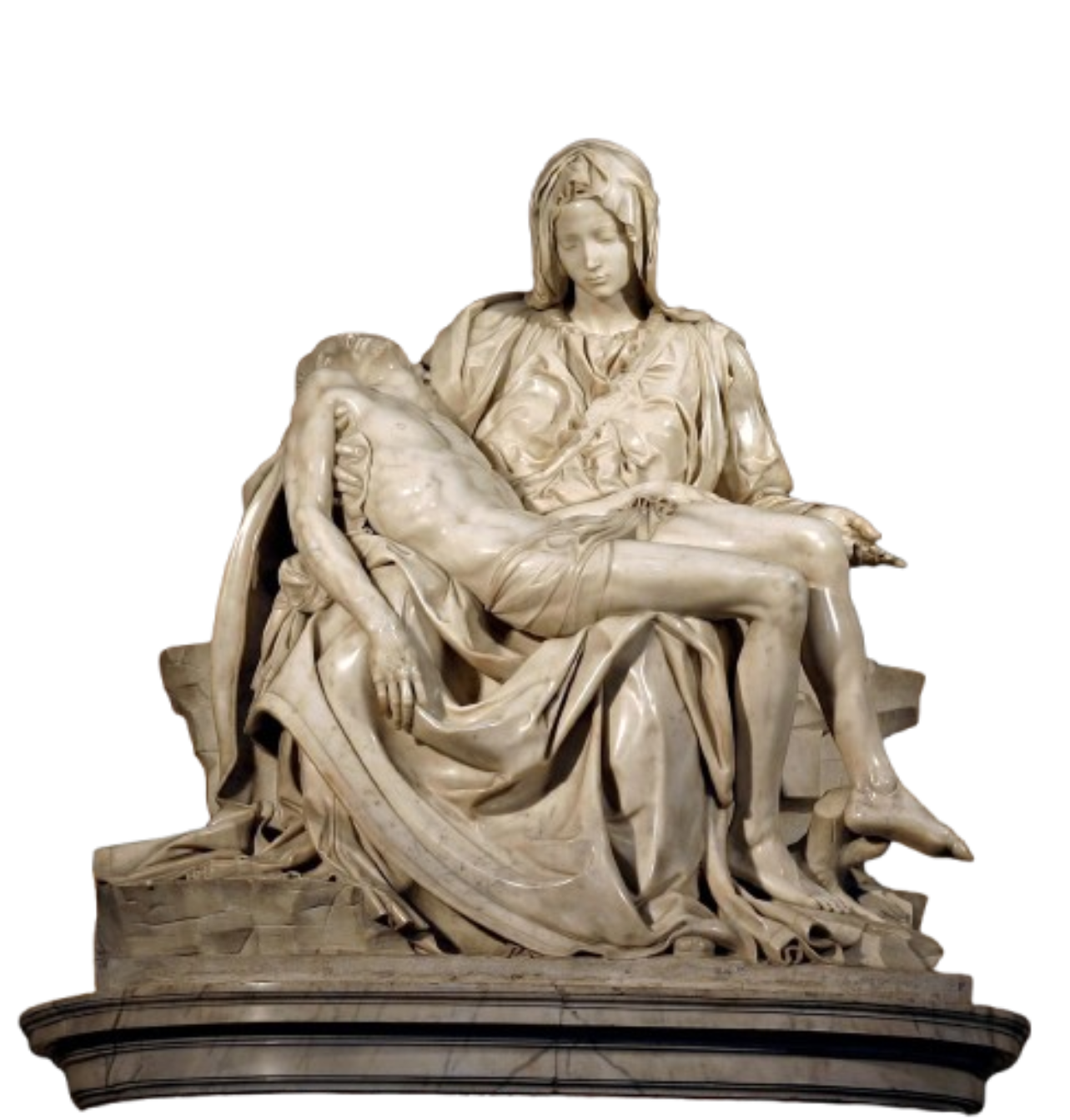
Moreover, romantic devotion and devotion to romanticism are two different things. The latter is not to see through rose-colored lenses, nor to live only to love, but to pursue great emotion in whatever form it may take, including the grief of loving.2 I have been meditating on Michelangelo’s Pietà in St. Peter’s Basilica, a symbol of Mary’s devotion to God through the surrender of her son, Jesus. Unlike other Pietàs before, this portrayal highlights a serene, youthful Mary instead of a pained, middle-aged woman. I wouldn’t go so far as to say that she isn’t sorrowful in this depiction, though her smooth countenance is one of acceptance.3 She accepts tragedy as part of her devotion. We artists are all Mary, born-again virgins, our hymen ruptured by our creation like Jesus out of Mary’s vaginal canal as if the amount of times we’ve been in the throes of passion cannot save us from the pain of bringing our art into the world. And even when we are not in the mode of creation, when we consume other people’s art, there is the punctum that pierces us over and over. We want it to. We are all suckers for the love songs being played on the radio and the soppy rom coms and the heart wrenching dramas. We want to be moved. We want to emerge out of the movie theater changed, even disturbed. And we want to be made anew by our art even as it rips us apart. This experience makes us ready to devote ourselves once again to the creative process, and perhaps also, to the pursuit of romanticism.
Also like Mary, who looks upon her son with the understanding that what has been given to her, she has always been destined to give back, we (artists, creatives, anyone who has the urge to bring the subconscious into the conscious realm) must surrender our creation back to the collective. Tune into that voice that says your work was always meant for more than just yourself. There is a reason that the major arcana ends with The World (XI); in completion, we join the cosmos. Releasing our work into The World is often done with great grief and uncertainty as much as it seems like it should be joyous. Capitalism wants us to believe that joy and fulfillment is made available to us once we produce fully-polished, manufactured project, but it’s not. Joy is in devotion. It is in laboring over a line of poetry for days or weeks or months, staying with an idea long enough to witness its evolution, from sketching, to underpainting, to believing in the vision enough to make it real. We should find joy in the slow coming together of our projects. Joy is making, pain is release, and back to work. Meanwhile, devotion is sacrifice. I’ll say it again. DEVOTION IS SACRIFICE. DEVOTION IS SACRIFICE. DEVOTION. IS. SACRIFICE!4
But how do we sustain our devotion? How do we be pious about our commitment to ourselves and our craft? How do we learn to listen to the God within us, to keep the channels open? Let us not forget, as I mentioned at the beginning of this article, devotion is a choice. It is choosing the same over and over again.
Cusp of Cami was born out of a need to occupy space on the internet, to mouth off mystical musings to whoever was willing to listen. What started as a place to share my love for astrology has evolved into a platform to document the struggles and pleasures of being a young writer. However, this Substack was also born out of depression, an unlikely gift. Depression both derailed me and brought me closer to where I’m mean to be. It’s been a sign of other illnesses in my life, a call to adjust accordingly. This past year, I’ve been rebuilding my life and becoming more aware of how much happiness and self-regulation are intentional practices. In other words, how much happiness and self-regulation are dependent on showing up. It’s not easy to show up. It’s even harder to show up after rejection and feeling misunderstood.
After years of being pinned to my bed by shame, despair, apathy, I will never again take for granted the ability to show up. Showing up counters stagnancy, still water attracting disease. This deceivingly simple act has been the first step towards devotion for me. The second step is showing up again. And again. And choosing. Again. And again. And again. For us fools who wish to make a living from bearing our souls, from the ritual humiliation of sharing our art, the name of the game is persistence.
Devotion, choice, discipline; these things return us to our humanity.5 But devotion is not always a grand gesture and it shouldn’t be. Devote yourself in ways big and small. Show up to your Notes app, your hermitage, your morning walk. Show up to your rec center art class, your missed texts, your breakfast. Just start showing up, and if you can, keep going.
A media queue for devotion
*a growing list– leave your suggestions in the comments!
Films
Books
My Year of Rest and Relaxation by Ottessa Moshfegh8
Mariette in Ecstasy by Ron Hansen
The Creative Act: A Way of Being by Rick Rubin

For anyone looking to be more devoted (to themselves, to living life at its fullest, to their art practice), I can’t recommend this YouTube channel enough.
Remember, the Gothic is an extension of the Romantic.
and her youth symbolic of a certainty that she can create again
I’m not sure Mary would think that the death of her son was unreasonable in the grand scheme of things, but I think Mary would agree that God is cruel. Yet she accepts this in her devotion to him.
See the Labours of Hercules.
On Whiplash and Black Swan– do I advise your devotion make you crazed, masochistic, and irrational? No. Well, maybe. I do believe that discomfort is necessary to transcend oneself. What transcendence is? That’s up to you. But I can tell what it is not– instant gratification. I don’t think true transcendence grows on a vine (ahem, ayahuasca), or is a drug you have yet to try, and just because you’ve dipped your toes into the counterculture does not mean that you’ve transcended the mainstream. Also, transcendence is not the MFA (it can’t be bought!). Can it be learned? Yes, perhaps through repetition.
Too literal? Too bad. I loved this movie and I hope you will too.
Hear me out– she gave up on showing up, butttt she devoted herself fully to her mission and she transcended!